
Micro-Break Routine: 4 Stretches to Do Every Hour at Your Desk
Long hours at a desk can leave your neck, shoulders, wrists, and back feeling stiff or uncomfortable. While stretching cannot replace regular movement, a simple micro-break routine can help you change position, relax tense muscles, and become more aware of your posture throughout the workday. Research suggests that workplace exercise programs may reduce musculoskeletal complaints, particularly in people who already experience neck or shoulder symptoms (Holzgreve et al., 2021).

At Thomas Back and Body in Georgetown, Ontario, we encourage desk workers to make movement and stretching a regular part of their workday. Set a reminder at the beginning of each hour and complete the following four stretches gently. The goal is to feel mild tension, but not pain.
Stretch Routine for Desk Workers
1. Neck Side Stretch
Sit tall with both feet supported on the floor. Relax your shoulders and slowly tilt your right ear toward your right shoulder. Keep your face pointing forward and avoid lifting the opposite shoulder. Hold for 10–20 seconds, return to centre, and repeat on the left side.

This stretch targets muscles along the side of the neck that may become tense when you look at a monitor for extended periods. Breathe normally and avoid pulling on your head.
2. Shoulder Blade Squeeze
Sit or stand with your arms relaxed at your sides. Gently draw your shoulder blades back and slightly down, as though trying to hold a pencil between them. Hold for five seconds, then release. Repeat five times.
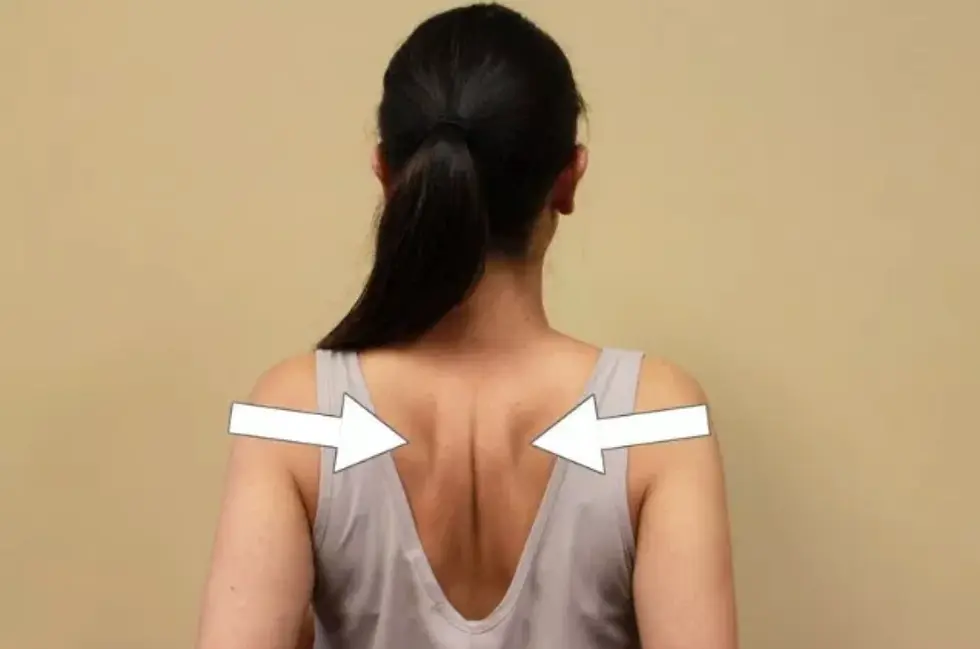
This movement promotes awareness of the upper-back muscles and counters the rounded-shoulder position that can develop during computer work. Strengthening and targeted exercise may be more effective than stretching alone for persistent neck pain, so consider this exercise one part of a broader movement plan (Louw et al., 2017).
3. Chest and Shoulder Stretch
Stand beside your desk and place one forearm against a doorframe or wall, with your elbow bent. Slowly turn your body away until you feel a gentle stretch across your chest and the front of your shoulder. Hold for 15–20 seconds, then switch sides.

Opening the chest can provide a useful change from prolonged forward-reaching at a keyboard. Keep the movement comfortable and do not force your shoulder backward.
4. Seated Hip Stretch
Move toward the front of your chair and place your right ankle over your left knee. Keeping your back comfortably straight, hinge forward slightly from your hips until you feel a stretch in the right hip and buttock. Hold for 15–20 seconds, then switch sides.

Make Movement Part of Your Workday
A micro-break should also include changing position. Stand, walk to refill your water, or complete a few gentle movements between tasks. Canadian workplace guidance recommends taking regular breaks from workstation activity, changing body position, breathing normally, and stopping if a stretch causes pain or severe discomfort (Canadian Centre for Occupational Health and Safety, 2025).
If discomfort persists, worsens, causes numbness or weakness, or interferes with daily activities, seek an assessment from a qualified healthcare professional. Contact Thomas Back and Body in Georgetown to discuss personalized strategies for improving movement, comfort, and spinal health at work.
References
Canadian Centre for Occupational Health and Safety. (2025). Office ergonomics—Stretching at the workstation. https://www.ccohs.ca/oshanswers/ergonomics/office/stretching.html
Holzgreve, F., Maltry, L., Hänel, J., Meusel, D., Schmidt, H., Bader, A., ... Groneberg, D. A. (2021). Office work and stretch training (OST) study: Effects on the musculoskeletal system and posture. BMJ Open, 11(5), e044453. https://doi.org/10.1136/bmjopen-2020-044453
Louw, S., Makwela, S., Manas, L., Meyer, L., Terblanche, D., & Brink, Y. (2017). Effectiveness of exercise in office workers with neck pain: A systematic review and meta-analysis. South African Journal of Physiotherapy, 73(1), 392. https://doi.org/10.4102/sajp.v73i1.392


Comments